

Your glass shower door has a white haze that won’t scrub off. The inside of your kettle looks like a coral reef. And the guy at the home show swore his salt-free “conditioner” does everything a softener does, for half the upkeep.
It doesn’t. But it isn’t a scam, either.
Here’s the short answer. Yes, you can use a water softener and a water conditioner together. In a lot of Homestead homes, the pair works better than either one alone. The catch is that each unit has to do a different job. A softener removes hardness minerals. A conditioner either changes how those minerals behave or treats the water for chlorine, chloramine, taste, and odor, depending on the type. Put two machines on the same job, and you’ve paid twice for one result.
We’re The Plumbers, and we’ve been handling water filtration and softener in Homestead, FL, along with the rest of South Florida, since 1996. We test the water, size the equipment, and fix what other installers leave behind. Below, we’ll explain what each system does, when a combo makes sense, the order it has to go in, and the mistakes we see most often on service calls.
What a Water Softener Actually Does
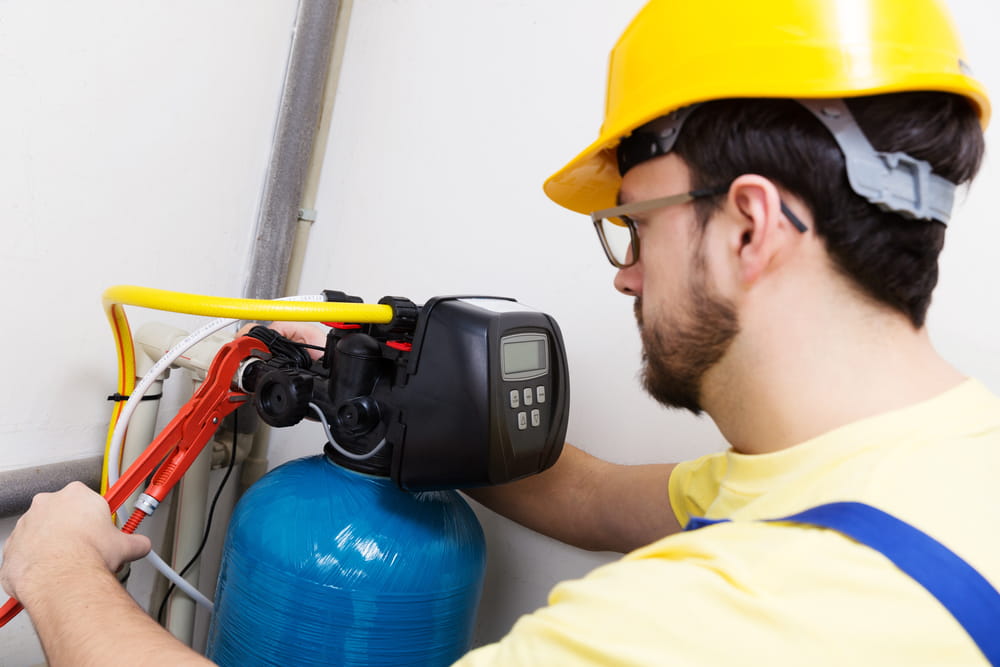
A water softener pulls calcium and magnesium out of your water through a process called ion exchange.
Inside the tank sits a bed of small resin beads. Those beads carry sodium (or potassium, if you choose potassium chloride pellets). As hard water flows through, the beads grab the calcium and magnesium and release sodium in their place. When the beads fill up, the system flushes them with salty water from the brine tank. That’s called regeneration. Modern units only regenerate when they’ve treated a set amount of water, which saves salt and water compared to older timer models.
Why does this matter in Homestead? Our water comes from the Biscayne Aquifer. That aquifer sits in porous limestone, and limestone is mostly calcium carbonate. Water moving through it picks up minerals the whole way. Utilities treat it before it reaches you, but plenty of homes around Homestead, Leisure City, and Florida City still land in the moderately hard to hard range. The U.S. Geological Survey calls anything from 61 to 120 milligrams per liter moderately hard and 121 to 180 hard.
A properly sized softener brings that close to zero. You’ll notice it fast. Soap lathers with less product. Dishes come out without spots. Towels feel softer. Your water heater, and especially a tankless heater, stops collecting scale on its heating surfaces.
There are trade-offs, and we tell every customer about them up front.
Softened water contains added sodium. The Water Quality Association estimates about 7.5 milligrams of sodium per quart for each grain per gallon of hardness removed. For most people that’s a small amount. For anyone on a doctor-ordered low-sodium diet, it’s worth a conversation. Potassium chloride pellets avoid the sodium issue but cost more per bag.
You also have to keep salt in the brine tank. Most families of four use one or two 40-pound bags a month, though it varies with hardness and water use. And each regeneration sends brine down the drain. Homes on septic, which you’ll find throughout the Redland, should have the discharge planned out during installation, not guessed at.
What a Water Conditioner Actually Does
“Water conditioner” is a loose term. Companies use it for two very different products, and that’s where most of the confusion starts.
Type one: salt-free scale conditioners. The most proven version uses template-assisted crystallization, often shortened to TAC. Water passes over a special media that turns dissolved calcium and magnesium into microscopic crystals. Those crystals stay suspended in the water and don’t stick to pipes, fixtures, or heating elements.
Notice what that means. The minerals are still in your water. A TAC conditioner reduces scale buildup, but it doesn’t make water “soft.” You’ll still get some spots on dark cars and glass. Soap won’t lather any better. The upside is real, though. There’s no salt, no brine discharge, no added sodium, and usually no electricity. The media typically needs replacing every few years.
TAC also has limits. It struggles when water carries iron, manganese, or high levels of sulfur, and most manufacturers want those removed first.
You may also see magnetic or electronic “descalers” sold as conditioners. Independent evidence for those is thin. We say that plainly when customers ask.
Type two: carbon-based conditioners. Some companies call a carbon filtration tank a conditioner. This unit doesn’t touch hardness at all. It removes chlorine, chloramine, bad taste, and odor.
This one is important in our area. Miami-Dade Water and Sewer, which serves many homes around Homestead, disinfects with chloramine, a blend of chlorine and ammonia. Chloramine lasts longer in the pipes than plain chlorine, which is good for public safety. It’s also harder to filter out. Standard carbon doesn’t do much against it. You need catalytic carbon, which is built for that job.
Softener vs. Conditioner: The Real Differences
If you remember one thing, make it this. A softener removes hardness. A salt-free conditioner changes hardness so it doesn’t stick. A carbon conditioner ignores hardness and cleans up chemicals.
That leads to very different results at the faucet.
For spot-free glass and dishes, only a softener delivers. For scale protection in pipes and water heaters, both a softener and a TAC conditioner work, with the softener giving stronger protection in very hard water. For chlorine or chloramine taste and smell, only a carbon system helps. For low maintenance, the salt-free conditioner wins, since there’s no salt to haul. For sodium-sensitive households, the conditioner or a potassium-based softener is the better fit.
No single box handles every problem. That’s exactly why the combo question comes up.
Can You Use Both Together?
Yes. The combination works when each unit covers a gap the other leaves open. Here are the setups we install most in the Homestead area.
Carbon conditioner plus softener (city water homes). This is our most common pairing. The carbon tank goes first and strips out chloramine. The softener goes second and removes hardness. You get better-tasting water, no scale, and no spots.
There’s a hidden bonus. Chlorine and chloramine slowly break down softener resin. Beads swell, lose capacity, and turn to mush over time. Putting carbon in front of the softener protects the resin and can add years to its life. On many service calls where a softener “stopped working” after a few years, the real cause was unfiltered chloramine eating the resin.
Pre-filtration plus softener (well water homes). Out in the Redland and the farm areas west of Krome Avenue, many homes still run on private wells. Well, water here can carry iron, sediment, and hydrogen sulfide, the gas that gives water a rotten-egg smell. Iron fouls softener resin. So we put a sediment filter and an iron or sulfur treatment system first, then the softener. In these homes, a whole-house water filter up front isn’t optional. It’s what keeps the softener working.
The combo that rarely makes sense: TAC conditioner plus softener in a row. Both target hardness. If the softener comes first, the TAC unit has almost nothing left to work on. If the TAC comes first, the softener still has to remove every mineral, because TAC doesn’t take anything out. You’d be paying for two systems to solve one problem. We talk people out of this setup more often than you’d expect.
The Right Order Matters
When you combine systems, the order decides whether the setup works or fails early. Our standard sequence for a full system looks like this:
First comes a sediment filter, which catches sand, rust flakes, and debris.
Next comes carbon or catalytic carbon, which removes chlorine, chloramine, and organic compounds.
Then the softener, which removes calcium and magnesium.
Last is an optional reverse osmosis system under the kitchen sink for drinking and cooking water. RO also removes most of the sodium a softener adds, which answers the sodium concern for a lot of families.
Every system should have its own bypass valve. That way we can service one unit without shutting off water to the whole house.
Placement matters too. Most Homestead homes put equipment in the garage, and garages here can get very hot for much of the year. We keep tanks out of direct sun, off bare dirt, and away from spots that flood during summer downpours. We also recommend a surge protector for the softener’s control head, since lightning is a regular part of our summer afternoons. Good water filtration system installation covers these details, not just connecting pipes.
One more local point. After a hurricane or tropical storm, boil-water notices are common. Once a notice lifts, your softener and filters may need sanitizing, and carbon cartridges may need replacing. We walk customers through this every storm season, which runs June 1 through November 30.
Mistakes We Fix All the Time
We see the same problems again and again, often from online kits or one-size-fits-all packages.
No water test before buying. Equipment gets sold based on a zip code, not an actual test. Then the softener is too small, or a TAC unit gets installed on iron-heavy well water and clogs.
Wrong softener size. Sizing depends on hardness, household size, and daily water use. A common rule is hardness in grains per gallon times the number of people times about 75 gallons per person per day. An undersized unit regenerates too often and wastes salt. An oversized one can let water sit too long between cycles.
Skipping chloramine protection. Standard carbon filters marketed for “chlorine” often do little against chloramine. The resin pays the price.
Units left on bypass. We regularly find softeners someone set to bypass during a repair and never switched back. The homeowner keeps buying salt for a system that isn’t treating anything.
Ignoring commercial needs. Restaurants, salons, laundromats, and offices along Krav and U.S. 1 deal with the same hard water, just at higher volume. Commercial ice machines, coffee brewers, and dishwashers scale up fast. Those clients need equipment rated for the flow, not a residential unit pushed past its limits.
How to Decide What Your Home Needs
Start with four questions.
Are you on city water or a private well? City water points you toward carbon plus softener. Well water usually needs sediment and iron treatment first.
What’s bothering you most? If it’s spots, crusty fixtures, and dry skin, you want a softener. If it’s only scale inside pipes and the water heater, a TAC conditioner may be enough. If it’s taste and smell, you need carbon.
Does anyone in the house need to limit sodium? If yes, look at potassium pellets, a salt-free option, or an RO drinking tap.
How much maintenance will you realistically do? Be honest. A softener that runs out of salt is just a tank in your garage.
Then get a real water test. We test hardness, iron, pH, chlorine or chloramine, and total dissolved solids before recommending anything. The results decide the setup, not a sales script.
Frequently Asked Questions
Can I install a water conditioner and a water softener together?
Yes, as long as they handle different problems. The most common pairing is a carbon conditioner for chloramine followed by a softener for hardness.
Does a salt-free conditioner make water soft?
No. It changes minerals so they don’t stick as scale, but the minerals stay in your water.
Which goes first, the conditioner or the softener?
A carbon conditioner goes before the softener. That order removes chloramine first and protects the softener’s resin beads.
Will a softener make my water salty?
It adds a small amount of sodium, but you won’t taste it at normal hardness levels. Potassium pellets or an RO drinking tap can reduce the concern.
Back to That Shower Door
That white haze on your glass is limestone from the Biscayne Aquifer, riding in on your tap water. A salt-free conditioner might keep it from building up inside your pipes, but it won’t clear it from the glass. A softener will. And if your water also tastes like a swimming pool, a carbon stage in front of that softener fixes the taste and protects the investment.
So yes, you can use both. You just need the right two, in the right order, sized for your actual water.
The Plumbers has served South Florida homes and businesses since 1996. We’re licensed and insured, open 24/7, and we offer same-day service and emergency repairs when a system fails. Every installation comes with some of the best warranties in the business. Call The Plumbers today to schedule your water test, and let’s build a system that fits your home, not a sales quota.
our general plumbing solution
At The Plumbers, we offer various solutions to meet every general plumbing need you may have.
We can help you locate leaks, unclog the drainage line, and fix any loose fittings. We also offer upgrading solutions for long-term solutions and comfort.
Sinks and faucets usually need constant attention because they encounter a lot of traffic. They are prone to clogs, leaks, and wear out due to age. Due to their critical role, The Plumbers ensures that we provide quality repair and replacement services to ensure they give maximum benefit.
After a stressful day, not being able to take a hot shower or soak in the bathtub can be frustrating, call The Plumbers to fix all your bathroom problems and even upgrade your shower and bathtub for stress-free days.
The Plumbers provide quality installation services for all plumbing units and fixtures. Whether you have a new building or need to replace and upgrade aged sections, we are the plumbing company to call.

Let us take care of your general plumbing needs
Working with The Plumbers guarantees efficiency and a long lifespan for all your plumbing units. Reach out to today and let the plumbing experts serve you with excellent general plumbing solutions. Call The Plumbers’ team or fill out the form to schedule an appointment.